Radon Mitigation in Bowling Green, KY
Typical cost: Most Warren County homes: $900 – $2,500 installed, verification test included
Mitigation is where a scary number becomes a solved problem. An active radon system puts continuous gentle suction on the soil and rock beneath your foundation — through a sealed suction point drilled in the slab, or through the sump pit so many Kentucky basements already have — and routes the gas up a PVC stack, past a quiet inline fan, to a discharge above the eave where it disperses into open air. Installed properly, it pulls even severely elevated homes below the EPA action level of 4.0 pCi/L, usually far below, and holds them there around the clock.
Kentucky houses give this work its local character. Basements — standard equipment on Kentucky homes — mean sump pits to seal and tap, block walls that breathe soil gas, and floor drains that need thought. Crawl spaces get membrane systems: the dirt sealed under heavy plastic, the suction drawn from beneath it. And the karst under everything means communication testing matters — checking how air actually moves under your particular slab before anyone drills — because limestone voids can make one suction point do the work of three, or demand a second one where the rock refuses to cooperate.
Every system is installed by a Kentucky Board of Radon Safety–certified mitigation professional — that is state law, not a boast — and every install ends the same way: penetrations sealed, a manometer on the pipe so you can see it working at a glance, and a post-installation verification test that proves the number before anyone calls the job done. The guarantee is written: below 4.0, or the work continues.
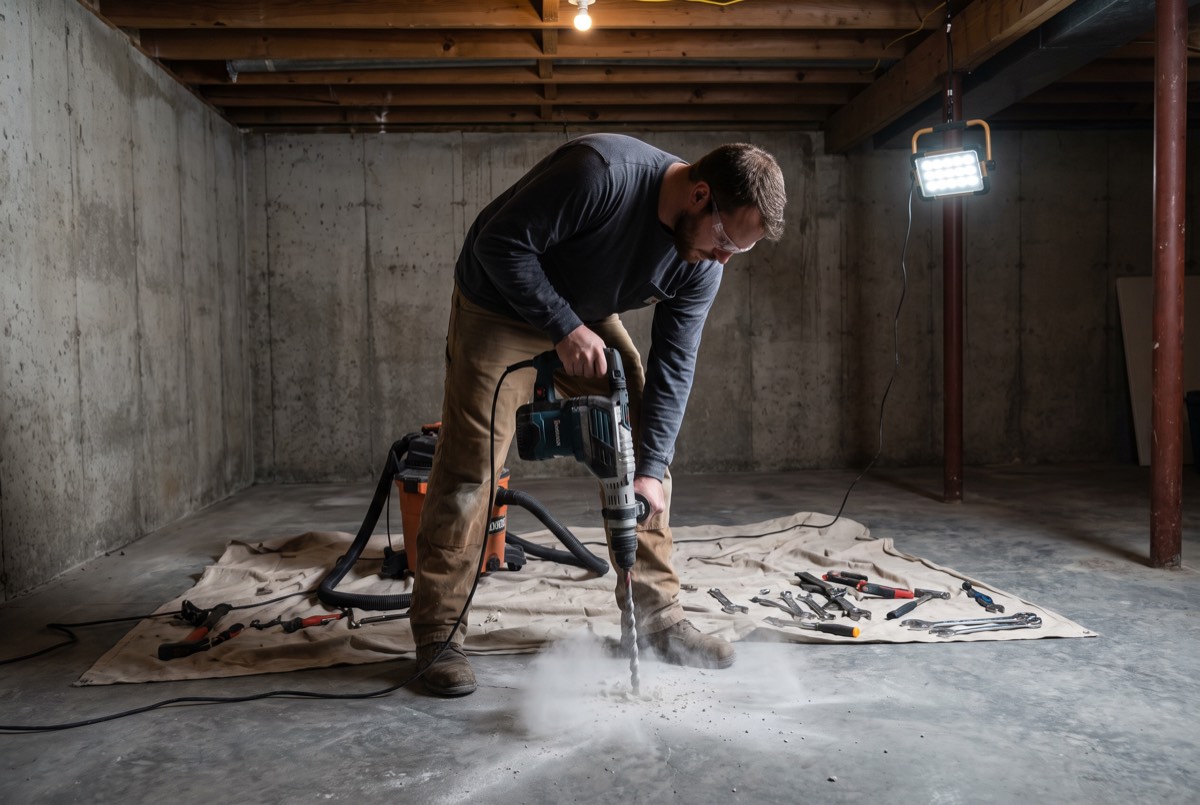
The suction point goes where the communication test says - karst rewards the measured approach.
What is included
- Sub-slab and sump-pit systems engineered for Kentucky basements
- Crawl space membrane systems with sealed sub-membrane suction
- Installed by KY Board of Radon Safety-certified professionals — required by state law
- Communication testing before drilling — karst rewards the measured approach
- Written guarantee below 4.0 pCi/L, verification test included
What a Bowling Green mitigation actually involves
A typical Warren County install runs a single working day. The crew evaluates the foundation — full basement, slab, crawl, or the half-and-half combinations this region loves — and runs a sub-slab communication test to map how air moves underneath. The suction point goes where the physics says, not where the drill is convenient: often the sump pit, sealed under an airtight dome and tapped directly, because the drainage layer feeding a sump is a ready-made radon collection network. The stack routes through the house or up an exterior wall, the fan goes in the attic or outside (never in living space — code), visible cracks and joints get sealed, and the system starts pulling before the crew leaves. Then the part that separates professionals from installers: a verification test, because the only honest measure of a radon system is the number it produces.
Karst limestone: why Bowling Green mitigation is its own specialty
The rock under Warren County is Swiss cheese — the same dissolving limestone that made Mammoth Cave, Lost River Cave and the sinkholes that occasionally make national news here. For radon work that cuts two ways. The voids and fractures can carry soil gas sideways long distances, which is why two identical houses on the same street can test wildly differently — and why your neighbor's low test tells you nothing about your house. But those same connected voids often respond beautifully to suction: a well-placed system can depressurize a wide footprint through the rock's own channels. Local experience with this geology is not a nice-to-have; it is the difference between a system designed and a system guessed.
Already have a number from an inspection?
If a home inspection or test kit put a figure in your hand — 6, 9, 15 pCi/L; Warren County produces them all — skip the dread and get the quote. Mitigation pricing here is mercifully boring: most homes land between $900 and $2,500 installed, the work takes a day, and the problem stays fixed for the life of the fan. For context, the EPA estimates radon causes about 21,000 U.S. lung cancer deaths a year — and it is among the most fixable environmental health risks a house can have.
Serving Bowling Green, Franklin, Glasgow, Scottsville, Russellville and nearby
This service is available across our full coverage area. See the service area map for the complete list, or call (270) 606-7712 to check a specific address.